Skip to content
News & Articles | Categories

Concrete Raising & Slabjacking Insights

Stay informed about EFT’s projects, techniques, and innovations in slabjacking and concrete raising.
polyurethane foam injection
January 20, 2011

Polyurethane Foam Injections for Concrete Raising

Problems with Sunken Concrete: Sunken concrete slabs create problems for building owners. Not only are they expensive to replace, sunken slabs can also interrupt the functionality of a commercial space. Warehouse floors are especially impacted by sunken concrete surfaces.

Expanding polymer foams are now replacing cement grout for raising concrete. Not only are they super-lightweight, urethane foams harden within minutes, allowing the concrete to be immediately used by forklifts and other heavy traffic.

Some of the notable qualities of closed-cell polyurethane foam include:

  • Lightweight: With densities ranging between 2 to 10 lbs/cubic foot, polyurethane foam is much lighter than traditional cement grouts, which can weight between 100 to 150 lbs/cubic foot. This lightweight characteristic will minimally overburden the soils below, greatly limiting future settlement potential.
  • Fast-Settling: Polyurethane foam generally hardens within 15 minutes. This benefit is greatly realized for lifting concrete highways, where traffic impact is a major factor in construction considerations.
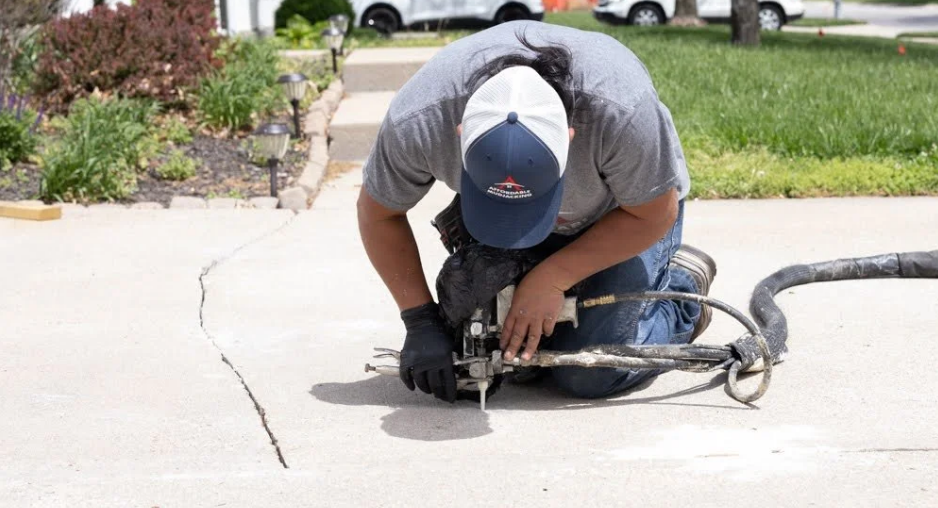
  • Smaller Injection Holes: 5/8" holes as opposed to 1-1/2" for traditional slabjacking. The holes are also spaced much further apart for polyurethane injections, resulting in much less concrete drilling.
  • Less Impact: The work is generally much cleaner than traditional concrete raising. Once the polyurethane injections are complete, the crew can simply pack up and prepare to demobilize. There is no equipment cleaning necessary with polyurethane work. Foam Insulation: Polyurethane foam provides thermal insulation to the concrete slabs. This benefit is especially realized concrete settles within a heated area.
  • Moisture Barrier: Closed-cell polyurethane provides a moisture barrier as well, helping reduce water migration through concrete floors. EFT is highly experienced with polymer foam technologies. Contact us to see how we can help with your project.
Read More
eft polyjacking techniques
November 03, 2010

Polyjacking: New Technique for Concrete Raising

Polyjacking:  A Cutting Edge Technology for Concrete Raising

Do you have a problem with sunken, uneven, or cracked concrete? Engineered Foundation Technologies ("EFT") of Nashua, New Hampshire has built a strong reputation throughout New England for providing effective solutions for these concrete problems. EFT's slabjacking, also known as mudjacking and pressure grouting, is a process that involves injecting grout underneath the concrete, filling in voids and eventually lifting the concrete back in place. EFT uses the technology to lift sidewalks, concrete ramps, concrete roadways, concrete patios, driveways, foundations, parking lots, garage floors, industrial floors, and basements. It is used in residential, commercial, and municipal applications.

Slabjacking is a cost-effective alternative to concrete replacement. The service can cost half the price of replacing a surface with a new concrete structure. Significant savings can be had when the work is done in tough areas where concrete demolition and removal are not required.

Engineering Foundation Technologies (www.slabjacking.com) remains as the premier provider of concrete slabjacking services in New England. And now, EFT is adding a newer technology for concrete raising to New England and the Northeast for the first time. EFT's polyurethane injection service uses high-density polyurethane foam for concrete lifting and stabilization. Now in use by engineers and various DOT's in the  Western portion of the county, polyurethane injections offer numerous advantages to traditional slabjacking methods. For instance, it only takes four pounds of polyurethane to fill what would have required up to 140 pounds of traditional cement grout.

Polyjacking avoids costly demolishing and replacement methods, allowing business to run smoothly around the concrete restoration project and avoiding down time. Polyurethane typically cures 15 minutes after injection allowing areas to be fully available in minutes. High-density polyurethane can be used in underwater or wet applications and have the same chemical reaction as when used in dry applications. And the characteristics of foam-like high-density polyurethane make it resistant to water penetration, ultimately creating a moisture barrier underneath the concrete slab.

EFT will continue to offer its dependable and effective slabjacking service to companies, governments, construction and engineering firms, and to individuals in Maine, New Hampshire, Vermont, Massachusetts and Northern Connecticut, while now also providing its cutting-edge polyurethane slabjacking service to customers with appropriate applications.

EFT's Richard Porter, P.E., said his polyurethane slabjacking technology is now his preferred method for most concrete raising projects.  "Polyurethane foam provides clients with the strongest concrete lifting technology available today.  We are pleased to be able to offer this high-tech service to the residential community as well." 

Contact us to see how we can help with your project.

Read More